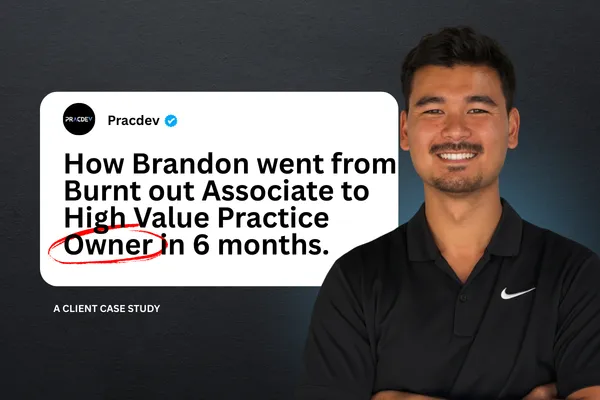
Chiropractic Case Study: Dr. Brandon Went From Burned-Out Associate → Practice Owner: Rebuilding Vision, Purpose, and a Model He Actually Believes In
When the Model Breaks, Not the Clinician
Brandon’s Case Study: From burned-out associate ready to quit → aligned clinician with a clear model, confidence, and momentum

There’s a version of burnout nobody talks about.
Not the “too many hours” burnout.
Not the “I need a holiday” burnout.
The one where you’re still showing up… but you’re not in it anymore.
You’re delivering care inside a system that doesn’t feel like you.
You’re saying words you don’t believe.
You’re selling plans that don’t match your values.
And the longer you stay, the more you start to think:
“Maybe I’m not cut out for this.”
That’s where Brandon was.
He wasn’t just tired.
He was done.
And the scary part wasn’t the job.
It was that he couldn’t see an alternative model that felt viable.
The mistake most associates make
When things feel heavy, they assume it’s a workplace problem.
So they change clinics.
But if your care, pricing, pace, and identity are still being defined by someone else…
you didn’t change the real thing.
You just changed the building.
Brandon tried that.
It didn’t fix it.
Because it wasn’t a job problem.
It was a model problem.
The context: “High volume is the only model that works”
Brandon was an associate inside a high-volume environment.
Everything was predefined:
how care was delivered
how fast he had to move
what patients were told
how pricing was positioned
what “success” looked like
And the deeper issue wasn’t that he couldn’t perform.
It was that he couldn’t align.
The emotional state
burnt out
disconnected
starting to resent the profession
drifting toward “I might just leave chiropractic”
This is important:
He wasn’t failing. He was misfit.
He was trying to win at a game he never chose.
What was actually holding him back
This wasn’t a confidence issue.
Confidence was the symptom.
The root was missing structure.
Brandon didn’t have:
a clear money model
language for value
clarity on who he wanted to help
a patient journey that reflected his belief system
a definition of success that was his, not inherited
He’d been trained to follow models.
Not design them.
And that’s the associate trap:
You learn how to deliver care inside someone else’s system…
but you never learn how to build a system that protects your identity.
So when you feel friction, you assume you’re the problem.
You’re not.
The model is.
The shift: slow down, rebuild from first principles
Most clinicians try to solve misalignment with tactics.
New scripts. New offers. New ads. New clinic.
But if the foundation is wrong, tactics just magnify the mismatch.
So we slowed everything down.
Not to “take a break.”
To rebuild the operating system.
Step 1: Identify the problem he actually cares about
Not “what gets results.”
What he can talk about for ten years without faking it.
Because passion doesn’t come from chiropractic.
It comes from the problem you solve.
When you’re solving problems you care about:
marketing gets easier
pricing gets cleaner
your energy returns
your identity stabilises
Step 2: Clarify who he wants to help (and why)
This is where most clinicians stay vague.
“I help everyone.”
“I do family care.”
“I work with pain.”
That’s not positioning. That’s a menu.
Brandon needed a clear patient lens:
who he serves
what they’re experiencing
what they’ve tried
what they believe
what outcome matters to them
When that clicked, his messaging stopped being generic.
And generic is what forces you into discounting, over-explaining, and chasing volume.
Step 3: Build a patient journey that matches his beliefs
A misaligned clinician doesn’t need a new technique.
They need a journey that feels congruent.
So we designed the pathway around:
how he wants to assess
how he wants to educate
how he wants to recommend care
what outcomes matter most
what the process needs to look like to feel ethical and clean
The goal wasn’t to copy a “successful clinic.”
The goal was to create a clinical experience he could stand behind without tension.
Step 4: Map the ideal day
This is the part people skip — and then wonder why they hate their practice.
We mapped:
what a day should feel like
how many patients is sustainable
how much thinking time he needs
how much space he wants
what he wants to protect (energy, family, training, hobbies)
Then we built backwards.
Because if your business model doesn’t protect your day, it will eventually eat you.
Step 5: The core equation
We distilled his model into a simple, repeatable equation:
Who he serves
What problem he solves
How he delivers value
This is the backbone of:
positioning
pricing
offers
marketing
content
ads
No equation = no clarity.
No clarity = defaulting to the clinic you trained in.
Step 6: Design a money model that supports the care
Here’s the truth:
Most clinicians undercharge because they don’t understand value.
They only understand time.
So they price like technicians.
But when you build a clear model:
value becomes visible
pricing becomes obvious
resistance drops
Brandon didn’t need to “get better at sales.”
He needed a value structure he believed in.
Step 7: Build a marketing plan guided by alignment, not tactics
This is where the Pracdev system becomes the difference.
Marketing isn’t “what do I post?”
Marketing is:
message
rhythm
identity
system
When those are clear, execution becomes simple.
When they’re unclear, you default to:
trends
gimmicks
copying
discounting
random boosting
Brandon didn’t throw everything out.
He kept what he enjoyed… and layered his own thinking on top.
That’s the move.
Not rebellion. Design.
The wins: tangible and intangible
The easiest way to spot a clean model is how it shows up in pricing.
Tangible wins
$129 appointments
$200 initials
zero resistance to pricing
previously charging about half and feeling wrong about it
This is the part people don’t understand:
Price resistance is rarely about the number.
It’s about clarity.
If the model is fuzzy, the patient feels it.
When the model is clean, the number feels normal.
Intangible wins
confidence is back
stress is down
energy is up
he looks healthier
he’s thinking bigger: space, growth, future
Most importantly:
He’s no longer “selling care.”
He’s guiding people through problems he genuinely cares about.
That’s what aligned practices do.
They don’t convince.
They lead.
Who Brandon became (and why that’s the real case study)
This isn’t a story about pricing.
It’s a story about identity.
Brandon is now:
strategic
intentional
aligned
authentic
no longer drifting
no longer copying
no longer forcing himself into models that don’t fit
He stopped following the crowd.
He started leading himself.
And that’s the real transformation:
Not new tactics. New operating system.
The framework lesson: this is Level 1 (and why it matters)
In Pracdev terms, Brandon wasn’t stuck because he needed more content or better ads.
He was stuck because Level 1 wasn’t built.
5 Levels Marketing OS — Level 1: Foundations
Level 1 isn’t “run ads.”
It’s:
identity
offer
pricing logic
patient journey
message
conversion pathway
If Level 1 is unclear, you can’t sustainably scale anything.
And if you’re an associate, Level 1 is often the first time you realise:
“I don’t need to leave the profession.
I need to leave the inherited model.”
That’s what Brandon did.
If you’re reading this and you feel like Brandon…
If you’re burnt out, don’t make it mean you’re not meant for chiropractic.
Make it mean you’ve outgrown the model you’re in.
Here are the signs it’s a model problem:
you feel tension recommending care
you over-explain pricing
you dread certain conversations
you feel “boxed” into a pace you don’t want
you can’t describe what makes you different without sounding generic
you’ve considered leaving entirely
You don’t need motivation.
You need design.
Your next step
👋 PracDev | The 28 Day Ad Reset:
Once you understand your model, then you can launch it and that’s exactly what we do inside the 28-Day Ad Reset (once you are ready to scale):
clarify your model
define your value
build the patient journey
clean up your messaging
THEN create a marketing rhythm that fits your identity
Because the goal isn’t to become louder.
It’s to become clearer.
And clarity is what creates momentum. Enquire Here 👈

Frequently Asked Questions
Is this case study only relevant if I want to own a practice?
No.
It’s relevant if you feel misaligned in your current role. Ownership was Brandon’s outcome, but the real lesson is learning how to design a model that fits you—whether as an associate, owner, or future owner.
Was Brandon burned out because of workload?
No.
His burnout wasn’t about hours or effort. It was about practicing inside a model that didn’t reflect his values, pace, or beliefs. This case study shows why burnout is often a model problem, not a motivation problem.
Did he just change clinics to fix this?
He tried that. It didn’t work.
Changing clinics without changing the underlying model only changes the environment, not the friction. The shift came when he rebuilt the system from first principles.
Did this require discounting or aggressive marketing?
No.
Once the model was clear, pricing resistance disappeared. Brandon moved to $129 appointments and $200 initials without pushback—because the value, journey, and message were aligned.
Is this about tactics, scripts, or ads?
No.
This is about Level 1 Foundations: identity, model, value, patient journey, and message. Tactics only work when the foundation is solid.
What if I feel like leaving chiropractic altogether?
That’s exactly who this is for.
This case study shows how feeling “done” with the profession can actually be a signal that you’ve outgrown the inherited model, not chiropractic itself.
What’s the next step if I relate to this?
Design before you scale.
Clarity first. Systems second. Marketing last.
That’s the sequence—and it’s exactly what we install inside the 28-Day Ad Reset, once your model is ready.
📌 Additional Resources
🏫 Join The Free Skool Community — The Influential Chiropractor
Free trainings, templates, ad breakdowns & resources.
https://skool.com/influential-chiropractors
🧭 Take the Clinic Growth Audit (Free)
Find out exactly what level your clinic is operating at — and what to build next.
www.pracdev.com/marketing-audit
💰 Download the Profit-First Marketing Roadmap
See the 5 Levels and get your personalised “next step” plan.
www.pracdev.com/5-levels
🎥 Join The 28 Day Ad Reset
5 new chiropractic ads every month + scripts + CRM + systems.
www.pracdev.com/ads


