The Core 4 Money Models That Make Chiropractic Ads Profitable
(And why your “ad strategy” collapses without them)
Most clinics that struggle with marketing are really struggling with math...
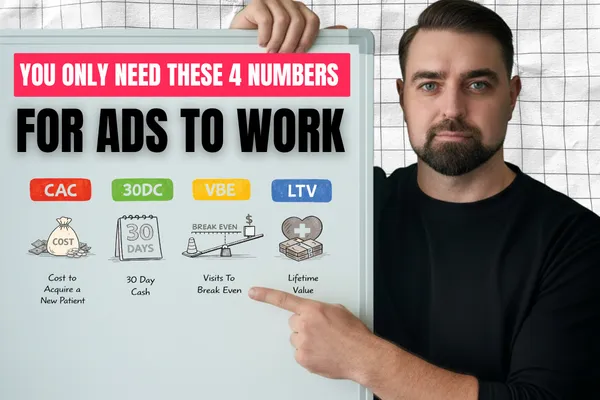
That's why I'm going to teach you the Core 4 - the 4 numbers that control the effectiveness of your marketing strategy.
A money models workshop: How to understand the numbers of marketing your practice...
1) You can’t build a house on a missing corner
Think of your marketing system like a table.
It needs four legs to stand.
You can have the best creative in the world, the cleanest branding, even the perfect targeting — but if one leg is missing, the table wobbles… and eventually breaks.
Those four legs are the only numbers that matter if you want ads to scale without panic:
CAC (Cost to Acquire a Patient)
30DC (30-Day Cash Collected)
VBE (Visits to Break Even)
LTV (Lifetime Value)
Without these, you’re gambling.
And the reason this matters is simple:
Ads amplify whatever system you already have.
If the economics are strong, ads scale profit.
If the economics are weak, ads scale stress.
2) What are the Core 4 Money Models?
Let’s get precise.
a) CAC — Cost to Acquire a Patient
What it costs to get a new patient who shows up.
Not “lead cost.” Not “click cost.”
Patient acquisition cost.
This is the number that determines your risk tolerance and how aggressively you can scale.
b) 30DC — 30-Day Cash Collected
How much money you actually collect in the first 30 days from that patient.
This is the “speed of payback.”
If you can collect meaningful revenue early, your marketing becomes self-funding.
c) VBE — Visits to Break Even
How many visits it takes before you’ve made back what you spent acquiring the patient.
This is the friction number.
The higher the VBE, the longer you’re floating ad spend.
Pracdev target: under 4 visits to break even.
d) LTV — Lifetime Value
The total revenue generated by that patient (or patient family) over the relationship.
This is your profit ceiling.
LTV determines whether you’re building a clinic that can expand… or one that’s stuck in short-term survival mode.
3) Where things break down (and what it looks like)
Here’s the honest truth:
Most clinics are running one of these “broken models” and trying to fix it with better ads.

Breakdown A: High CAC + Low 30DC
Symptoms:
Ads bring people in, but cash collected early is weak
You feel like you’re constantly “behind”
You stop ads because it feels like a leak
What it means:
Your marketing is "expensive" likely due to Ad creative (low volume) or a conversion milestone ie - appointment setting, show rate, day 2 show or ROF conversion BUT whilst your CAC is high, it is also your recommendations that need work. Patients are either being recommended too little or they stop showing.

Breakdown B: High CAC + High VBE
Symptoms:
You need 6–10 visits to recoup ad spend
You’re floating costs for too long
It “works” but it’s stressful and cash-flow heavy
What it means:
Your front-end conversion milestones need optimising - offer clarity, ad creative, appointment setting, consult conversion, care plan communication. Lower CAC by identifying then fixing the core issue.

Breakdown C: Low CAC + Low LTV
Symptoms:
Leads are cheap, patients start, but they don’t stay
You’re always replacing people
Growth feels like pushing a boulder uphill
What it means:
Your clinic is operating on “constant churn.”
Even if ads look good, the system can’t compound because retention and plan completion are weak. You are constantly relying on "New blood" coming through the door. This is a retention issue.
4) How to diagnose (and what it means for your system)
Here’s the clean diagnostic path:
Step 1: Start with CAC
If CAC is too high:
Ads: Create better ads with better hooks minimum of 5 per month
Appointment setting: Focus on speed to lead, script quality, and call frequency
Nurture: Build a 10 day SMS and email sequence for immediate follow up
Show rate: use show maximisers, notifications,
But don’t stop here. CAC is only one leg.
Step 2: Check 30DC (the payback speed)
Ask: “From a new patient, what do we collect in 30 days?”
If it’s low, your system is saying:
The offer isn’t clear enough
The consult isn’t converting
Your care plan conversation is weak
Or your front-end pathway isn’t designed to monetize quickly
This is where “we need more leads” becomes a trap.
Because more leads won’t fix low 30-day cash.
Step 3: Calculate VBE
VBE tells you how long your ads must “float.”
If you’re breaking even after 7 visits, you’re basically financing the clinic with ad spend.
That’s why clinics stop ads. Not because ads don’t work — because the economics feel unsafe.
Target: under 4 visits to break even.
Step 4: Confirm LTV
LTV is your scale permission slip.
If LTV is low, scaling ads will just scale a leaky bucket.
That diagnosis usually points to:
weak retention systems
inconsistent care plan completion
lack of reactivation and internal comms (Levels 2 and 3 problems)
The money model standards (Pracdev targets)
These aren’t “nice to have.” They’re the profitability baseline:
Under 4 visits to break even
3:1 ratio of 30DC to CAC
15:1 ratio of LTV to CAC
When clinics hit these, ads stop being stressful.
They become predictable.
And once ads are predictable, you can actually run the rest of the 5 Levels:
Level 2: Reactivation (raises LTV, lowers CAC pressure)
Level 3: Communication (raises conversions + retention)
Level 4/5: Expansion + automation
Why this is the real “ads strategy”
You can have:
the best ad scripts
the best editing
the best targeting
the cleanest branding
…but if these 4 numbers aren’t stable, the machine breaks.
Want to know if your marketing is profitable? 👇

🧭 Take the Clinic Growth Audit
Find out exactly what level your clinic is operating at — and what to build next.
www.pracdev.com/marketing-audit


