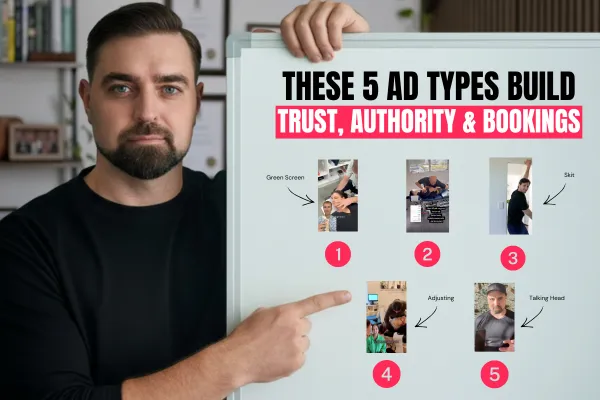
These 5 Ad Types Build Trust, Authority & Bookings (Start Here)
If you're a chiropractor running Facebook ads, Instagram ads, or short-form video campaigns and wondering why your results are inconsistent — you're not alone. The truth is that most chiro ads fail because they lack message clarity, personal presence, structure, and system support.
This guide explains exactly why chiropractic ads underperform, what modern patients respond to, and how to build ads that generate predictable, high-quality new patients using message-driven creative — not cheap gimmicks.
You’ll get a breakdown of:
Why most chiro ads fail
What actually works
The 5 Chiropractic Ad Types
Talking Head → Adjustments → Fly on the Wall → POV → Overlay Styles
Scripts, templates, and filming tips
A pre-launch checklist to ensure your ads perform
If you're ready to improve your NP volume, CPL, trust, and brand authority — start here.
TL;DR
Most chiropractic ads fail because they are generic, white-labelled, vague, or unsupported by a full marketing system. Patients no longer respond to cookie-cutter discount ads — they connect with real chiropractors, clear messaging, and consistent content.
This article breaks down why most ads underperform, what actually works, and how to use the 5 Ad Types to improve lead quality, trust, and conversions — without gimmicks.
Why Most Chiro Ads Don’t Work...
If you’ve ever run an ad and thought,
"This should be working… why isn’t it?"
You’re not alone.
The truth is, most Chiropractic advertising falls flat. Not because they were bad ideas, but because they were built without a clear strategy.
Here’s where they often miss the mark:
They don’t really say anything. Vague health claims and overused hooks don’t speak to real problems your community is facing.
They feel like an ad. Not a story. Not a connection. Just a push to book something.
They show up without support. A single ad with no content behind it is like a billboard in the desert — no one’s around to see it twice.
They focus on taking, not giving. And in a world full of offers, people connect with value first.
Worst of all...They're generic or white-labelled. Someone else’s face. Someone else’s words. It might sound polished, but it doesn’t sound or look like you.
This sound familiar...?
“Hey Springfield, 👋 I’m Dr. Angus from Hacky’s Chiropractic and I’m doing something AWESOME to promote my Chiro clinic...”
🤢
Yuck...
The good news? There’s a better way. And it’s not about shouting louder, sounding like everyone else or spending more — it’s about showing up authentically, with the right structure behind you.
What Actually Works...
Good ads don’t just get attention
They help people understand your offer, your process, and your purpose.
When someone sees your ad, they should walk away knowing:
What you do
How you help
Who you help
What they can expect next
In other words, a good ad either explains:
✅ The Offer – what they’re actually booking into
✅ The Process – what happens step by step
✅ The Outcome – what their life could look like after care
✅ The Pain/Symptom – what they’re dealing with and why it matters
✅ The Pathway – how to go from problem to solution
If you’re doing a New Patient consult offer (most often an Initial consult & report of findings), your goal is to help someone understand why they’re stuck and how your care finds & addresses the root cause.
When you communicate clearly — with structure and story — patients start to see the value before they even walk in.
And that’s where the 5 Ad Types come in.
Each one has a role to play in explaining your value and building trust — quickly, authentically, and consistently.
Let’s break them down.
🎥 Ad Type 1: The Talking Head
The foundation of trust, story, and personal connection.
✅ What It Is
A Talking Head video is you — the chiropractor — speaking directly to camera in a clear, confident tone. It’s the simplest and most effective format to explain, educate, and connect.
💡 Why It Works
Builds trust and authority quickly
Feels personal — patients see you, not stock footage
Allows you to explain the offer, the process, or the outcome
Creates familiarity before someone even walks into your practice
🔄 Variations (Pick What Feels Natural)
Style
What It Does
1. Selfie Style (Clinic Walkthrough)
Approachable and real. Walk + talk through your space. Show the vibe and your voice.
2. Whiteboard Explainer
Break down complex ideas visually. Great for explaining care plans, the offer or symptoms.
3. Talking Head + B-Roll
Film your script, then overlay with clips of your clinic, adjustments, X-rays, consults, etc.
4. Skit / Self-Convo
Two-character dialogue (you as chiro + patient). Use humour or relatability.
5. Problem → Solution
A direct, empathetic message addressing a symptom and the path to relief.
📝 Script Template
(Keep it under 60–90 seconds total)
Hook:
“If you’re struggling with lower back pain, headaches, or stiffness — this one’s for you.”
Value Statement:
“For over [X years], we’ve helped people just like you feel better, move better, and take control of their health naturally — without relying on medication.”
Process:
“We don’t guess. We run thorough assessments, including digital X-rays, to find the root cause. From there, we map out a personalised plan built to get you long-term results.”
Guarantee (if applicable):
“If we can’t help you, we’ll refer you to someone who can — and refund your consult. No pressure, no risk.”
CTA:
“Click the link below to book your New Patient visit. We’d love to help.”
🎬 Filming Tips
Use natural light or a soft ring light
Audio matters more than visuals — use a lapel mic or wireless setup
Keep the camera steady (tripod or books) at eye level
Film in portrait for Reels/stories, landscape for ads
Speak with energy, not perfection
Eye contact with the lens = builds trust
✨ Bonus Visuals (B-Roll Ideas)
Add these into edits to make your Talking Head content even stronger:
Patient waving at front entrance
Warm welcome at reception
Exam process + posture scans
Adjustments (neck, lumbar, hips)
Tools (activator, drop table, massage gun)
Patient smiling as they leave
🔧 Ad Type 2: Adjustments
Engaging, satisfying, and often the most-watched type of Chiro content.
✅ What It Is
Raw or lightly edited clips of real patient adjustments — showcasing hands-on care, technique, and patient reactions. These can be filmed as standalone content or woven into a story or consultation recap.
💡 Why It Works
People are naturally drawn to the sound and sight of adjustments
Shows the action behind the care you provide
Builds familiarity with your process (especially for nervous new patients)
Often your highest engagement content — great for reach and retargeting
Helps answer the question: “What actually happens during a visit?”
🔄 Variations (Pick What Fits Your Practice)
Style
What It Does
1. Full Adjustment Clip
Raw, start-to-finish adjustment (with patient consent).
2. Compilation
Series of clips edited together — high engagement, satisfying to watch.
3. Adjustment + Voiceover
Record your adjustment session, then overlay voice explaining what’s happening.
4. Slow-Mo Reaction
Capture patient reactions (laughter, shock, relief) — adds emotion and relatability.
5. Before/After Movement Test
Show what changes pre- and post-adjustment to reinforce the value.
🗣️ Script Template (Voiceover Option)
If you want to narrate over your adjustment clips:
Intro:
“Here’s a quick look at a recent adjustment with one of our patients dealing with lower back tension.”
Explain:
“We started with some mobility testing, found the restriction in her lumbar spine, and used a gentle side-posture adjustment to restore movement.”
Wrap-Up:
“If you’re dealing with similar issues — our Initial consultation offer is perfect to find out exactly what may be causing your issue and how we can help, pick yours up for $x.”
🎥 Filming Tips
Always get clear, signed patient consent
Use a tripod for clean, stable footage — or a staff member as videographer
Film close enough to capture detail, but wide enough to show body movement
Minimise background noise
Use portrait mode for stories, landscape for YouTube or longer reels
Capture reaction shots (before & after expressions, comments)
⚠️ Pro Tips
Never force a reaction — keep it real
Focus on relief, not drama
Use captions or explainers to highlight the purpose behind each adjustment
Always speak to safety and patient comfort
👀 Ad Type 3: Fly on the Wall
Real moments. Zero scripting. Just you doing what you do best.
✅ What It Is
This ad style captures unscripted, authentic interactions between you and your patients or team. Think of it like giving people a sneak peek into your clinic without making it feel staged.
💡 Why It Works
Feels natural, not produced — people feel like they’re observing, not being sold to
Builds emotional connection through real conversations and micro-moments
Showcases your clinic culture, tone, and energy
Helps reduce new patient anxiety by showing what actually happens
🔄 Variations (Keep It Real)
Style
What It Does
1. First Visit Walkthrough
Patient walking in, greeting, forms, first convo.
2. Consult Snippets
“Let’s take a look at your posture here…” — brief but powerful.
3. Adjustments + Dialogue
Light convo during treatment — not scripted, just real.
4. Team Moments
Banter at the front desk, team prepping rooms, staff laughing.
5. Behind-the-Scenes
You reviewing X-rays, writing up care plans, setting up for the day.
🎙️ Not Scripted… But Guided
To help your team film these naturally:
Pick moments where you're comfortable being filmed
Have your videographer stay in the background — no directing
If needed, narrate over the footage later to explain what’s happening
Focus on connection, not perfection
🎥 Filming Tips
Use a stabilised phone or gimbal
Capture clear audio, or record clean visuals and add a voiceover
Keep it short — attention spans drop fast if there’s no structure
Shoot in well-lit areas and avoid filming private info or sensitive convos
B-roll transitions (walking, scanning, laughing) make it feel natural
🧠 Think of This As:
Your clinic reality show — except it’s real
A tool to build deep familiarity before someone even books
The most passive trust-building content you can create
🎙️ Ad Type 4: POV / Voiceover / Case Story
You guide the viewer through the patient journey — start to finish.
✅ What It Is
This ad style is filmed from their point of view with a voiceover, walking through what care looks like, what a patient goes through, or what outcomes were achieved.
It’s not staged — it’s story-driven and educational.
💡 Why It Works
Creates empathy by centring the patient’s experience
Shows the step-by-step journey clearly
Builds trust through real outcomes and a guided explanation
Helps new patients understand your process and philosophy
🔄 Variations (Choose Based on Comfort + Consent)
1. Case Study Voiceover
“This is Sarah. She came in with XYZ…” Walkthrough from pain to progress.
2. Visit Recap
Narrate what happened during a consult or adjustment.
3. POV Footage
Film over their/your shoulder or via GoPro-style angle to show the process.
4. X-Ray or Scan Explainer
Break down visuals of posture, degeneration, or improvements.
5. Treatment Timeline
Series of clips showing progress across multiple visits.
🗣️ Script Structure (Case Story Style)
Intro (Who/What):
“This is James. He came in with chronic mid-back pain and headaches that had been bothering him for over 6 months.”
Middle (Process):
“On his first visit, we ran a full postural and X-ray assessment. We found key restrictions in his thoracic spine and neck alignment.”
Resolution (Outcome):
“After 4 weeks of targeted adjustments and rehab, his headaches were gone and his posture had visibly improved.”
CTA:
“If this sounds familiar — reach out. You don’t have to just put up with it.”
🎥 Filming Tips
Record your visuals first (clinic, consult, X-ray, movement tests)
Write a loose script, then record your voiceover in Descript or CapCut
Use subtle music in the background for storytelling effect
Use on-screen text for key points (dates, symptoms, milestones)
Don’t over-edit — it should still feel real
🧠 Best For:
Chiros who want to build trust without always being on camera
Explaining the care journey clearly and visually
Ads with depth — slower pace, more meaning, more impact
🖼️ Ad Type 5: Overlays
Simple, scroll-stopping visuals with powerful messaging.
✅ What It Is
This ad style uses text overlays, images, or short silent videos to deliver a clear message — fast. It’s the easiest content to produce, and one of the most effective when done right.
You’re not talking to camera here. You’re letting the message speak for itself.
💡 Why It Works
Instantly grabs attention in the feed
No audio required — perfect for silent scrollers
Great for communicating proof, positioning, and problems
Easy to repurpose for ads, stories, or reels
🔄 Variations (Minimal Effort, Maximum Value)
1. Action Shots
Show the hands-on nature of care — e.g. adjustments, scanning, consulting. These bring energy and motion to otherwise static content.
2. Reaction Images
Capture emotional moments — relief, laughter, "wow" faces post-adjustment. Real expressions create real connection.
3. Whiteboard / Chalkboard Shots
Write the offer on a whiteboard/chalkboard or any other creative space and have a doc/team member point to it.
4. Bold Question Slide
Overlay bold text like: “Still waking up with neck pain?” on clinic visuals or gradient backgrounds. Stops the scroll immediately.
5. Quote Over Footage
Combine clinic B-roll or slow-motion shots with short, sharp statements like: “We don’t guess. We test.”
6. Text-Only Image (or Video)
Full-screen quote or insight — clean text on solid colour or soft background. Works well as standalone or in a series.
7. Offer-Driven Overlays
Use image or video with on-screen text to highlight: “Initial Consult + Digital X-Rays – Now $XX” (AHPRA-compliant wording, of course).
8. Images That Speak for Themselves
Photos with emotional depth — a patient walking tall out of your clinic, a moment of connection, or a posture transformation. Let the image tell the story. (Aus chiros: always follow AHPRA guidelines.)
🧠 Copy Prompts for Overlays
“We don’t just treat symptoms. We find the root cause.”
“Over 150 locals helped this year.”
“This isn’t a quick fix. It’s the start of a better life.”
“Struggling with [condition]? You’re not alone — and there’s a solution.”
“Your journey to better starts here.”
🎥 Filming & Design Tips
Use a tripod or stable footage
Add clean, bold sans-serif text (white or yellow works well)
Use background footage of:
Clinic walk-through
Adjustments (blurred or silhouetted)
Staff smiling or working
Street signage or entrance
Add logo and simple CTA at the end
🛠️ Tools for Quick Creation
CapCut – Great for mobile video edits
Canva – Perfect for static image ads or carousels
Captions.ai – Add dynamic subtitles or text overlays
Descript – Clean video editing and voiceover recording
🔁 Great For:
Quick-turnaround ads
Retargeting warm audiences
Highlighting key moments without needing to speak
🎥 How to Film Them (Without Overthinking It)
You don’t need a studio. You just need to start.
The best content isn’t always the most polished — it’s the most relatable and consistent. Here’s how to get great footage without feeling like you need a production crew.
🧱 Start Simple: Your Filming Checklist
📱 Phone Camera: More than enough. Clean your lens before filming.
💡 Lighting: Face a window for natural light, or use a ring light.
🎙️ Audio: Use a lapel mic or wireless mic for clear sound — this matters most.
📐 Tripod or Books: Keep the frame steady and at eye level.
📏 Framing: Leave a little space above your head, film chest-up or full body depending on the scene.
🔊 Quiet Room: Turn off fans, music, and notifications.
🎬 Filming Tips to Keep It Easy
Film One Section at a Time: Break your script into chunks. Easier to get through and sounds more natural.
Don’t Memorise, Internalise: Know the points. Say them your way.
Use the First Take Energy: Often your first or second take is the best — don’t over-polish.
Make Mistakes? Keep Going: You’re human. That’s the point.
Short > Perfect: Aim for 30–60 seconds per video. Under 90 is ideal.
🎨 Capture Extra B-Roll (You’ll Thank Yourself Later)
These are gold for editing:
Walking into clinic
Greeting a patient
Initial assessment
Posture checks / scans
Adjustments
Clinic tools in use
Writing care notes
Team moments / high-fives
🎥 Shoot It 3 Ways (Optional But Powerful)
Talking to camera directly
Same line while walking
Overlay with B-roll later
You can reuse the same script across different styles for weeks of content.
🎯 Pro-Level with Minimal Editing
CapCut: Great for mobile — trim clips, add text or music
Descript: Record & edit desktop content with captions
Captions.ai: Add fast, bold, auto-generated subtitles
Canva: Great for static ads or carousel posts
⚡ Pro Tip: You’re not filming a movie. You’re building familiarity.
That means showing up consistently > showing up perfectly.
✅ The Chiro Ad Launch Checklist
Run through this list before you post or promote — every time.
Creating a great video is one thing.
Making sure it connects, lands, and works as an ad is another.
Here’s your simple pre-launch checklist to make sure your content does its job.
🎯 Core Message
Does this ad explain either the offer, the process, the outcome, the pain/symptom, or the pathway?
Is your message clear and relevant to your ideal patient?
🧑🤝🧑 Personal Connection
Do you appear in the ad? (Voice, face, story)
Does the video feel like you, not a generic ad?
Is your ideal patient featured or represented?
🧠 Educational Value
Does the ad teach or explain something — even briefly?
Is there context to what’s being shown?
⚡ Energy & Clarity
Is the video under 90 seconds (ideally 30–60)?
Is there a clear hook or opening line?
Are you using captions or text overlay?
📢 Call to Action
Did you invite the viewer to take a step (book, message, learn more)?
Is the CTA simple and specific?
📲 Technical Setup
Is the sound clear and audible?
Is the video framed well and well-lit?
Have you formatted it for the right platform? (Portrait for Reels/Stories, landscape for YouTube/FB feed)
💡 Pro Tip: You can reuse this checklist as a scorecard for your team or for content batching days.
FAQ — Chiropractic Advertising
1. Why don’t Facebook ads work for most chiropractors?
Because most clinics use generic templates, vague claims, discount-driven offers, or rely on old agency models that no longer connect with modern consumers. Ads must be personal, structured, and supported by a system (content + nurture + brand consistency).
2. Do chiropractic adjustment videos still work?
Yes — adjustment content is still highly engaging. But it must be paired with Talking Head videos, case stories, POV clips, and nurture systems to convert into actual bookings.
3. What ad type performs best for chiropractors?
Talking Head ads — because patients choose people, not professions. Your face builds trust faster than any stock footage ad ever will.
4. How many ads should a chiropractic clinic run per month?
Ideally 5 new ads every 30 days, across the 5 Ad Types. This prevents ad fatigue and builds familiarity.
5. Should chiropractors use white-label ads?
No. They are generic, overused across hundreds of clinics, and weaken your brand. Modern marketing requires authentic, message-driven content filmed by the chiropractor.
6. Do chiropractic ads need a funnel?
Not always. A simple landing page, booking link, or lead form combined with content + nurture sequences is more effective than complex funnels.
7. What is the fastest way to improve chiropractic ad results?
Add a Talking Head video
Clarify the offer
Add B-roll
Improve audio quality
Use a 10-day nurture sequence
Follow up leads immediately with human calls
8. Do I have to be good on camera?
No — you just need to show up. Authentic beats polished every time.
9. Should I run ads without content?
You can, but you’ll pay more. Content reduces CPL, boosts trust, and gives your ads a warm audience to retarget.
10. How long should chiropractic ads be?
30–60 seconds is ideal. Under 90 seconds total.
Want help with your New Patient Marketing?Book A Call With Pracdev

📌 Additional Resources
🏫 Join The Free Skool Community — The Influential Chiropractor
Free trainings, templates, ad breakdowns & resources.
https://skool.com/influential-chiropractors
🧭 Take the Clinic Growth Audit (Free)
Find out exactly what level your clinic is operating at — and what to build next.
www.pracdev.com/marketing-audit
💰 Download the Profit-First Marketing Roadmap
See the 5 Levels and get your personalised “next step” plan.
www.pracdev.com/5-levels
🎥 Join The 28 Day Ad Reset
5 new chiropractic ads every month + scripts + CRM + systems.
www.pracdev.com/ads


